
Mines at CaptainsBet Kenya: The Mine Game Explained
Mines is a risk game from Spribe, released in September 2021, with an advertised RTP of 97%: on a 5×5 grid, you choose how many mines are hidden and open tiles until you decide to cash out. At CaptainsBet it sits in the Fast Games section, allows 1 to 20 mines per round and has a maximum multiplier of 10,000x.

Key facts
- Provider: Spribe, September 2021. A fixed 5×5 grid, 25 tiles in total.
- RTP: 97% — a long-term theoretical average, never the expected result of one session.
- Stake per round: from a few shillings, with the exact minimum and maximum in the game info.
- Maximum multiplier: 10,000x, only reachable with extreme-risk settings.
- Where it is: the Fast Games section, next to the other short-round games at CaptainsBet Kenya casino and sports betting.
- The only real decision: how many mines you put on the grid. Everything else is pace and patience.
The grid is in the Fast Games section. 18+ only. Bet responsibly.
Mines game specs
Before talking about risk, it helps to have the numbers in front of you. Everything in this table comes from the game’s info sheet — and that sheet, available from the menu inside Mines, is the final word if you’re unsure about a specific limit.
How do you play Mines?
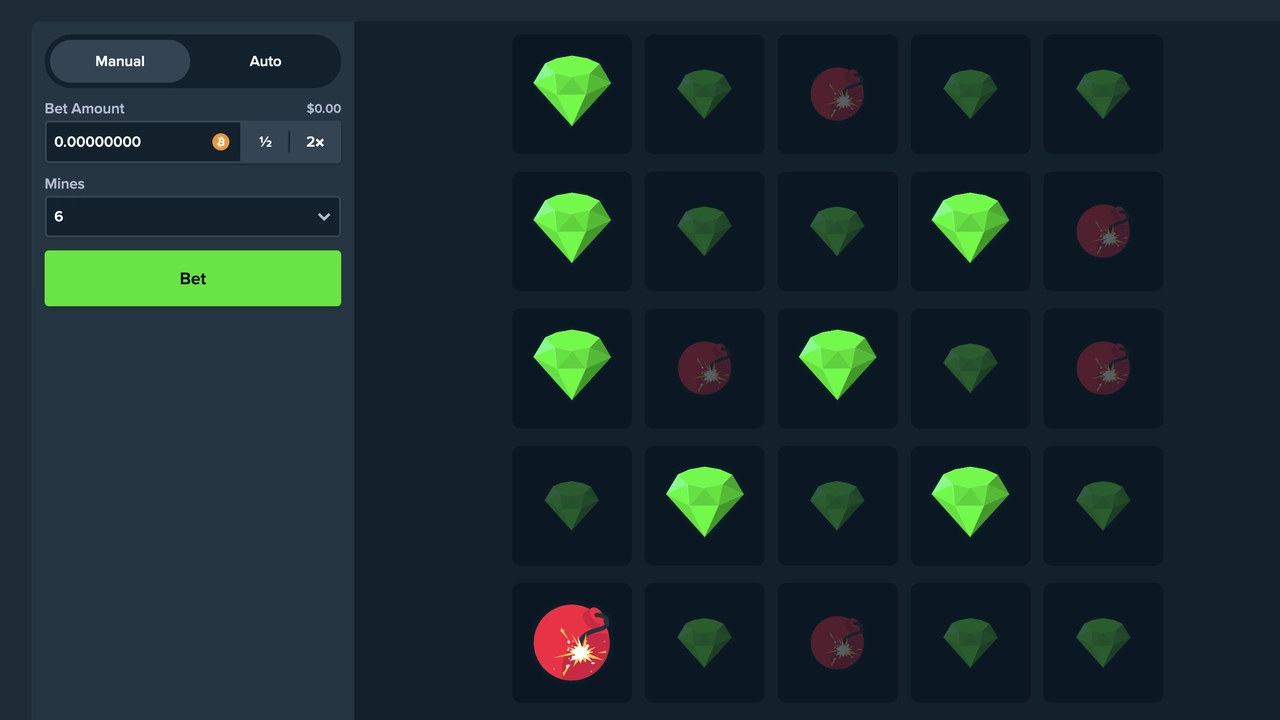
Choose your stake and the number of mines, open tiles one at a time and hit cash out before you land on a mine — if you do, you lose that round’s stake and the grid resets. Every safe tile reveals a star and pushes your running multiplier higher; your win is your stake multiplied by the value at the moment you cash out. This guide to Mines — how to play, what RTP to expect and what changes with the number of mines — follows the official game sheet step by step.
Open the game
Go to the Fast Games tab and pick Mines. The 25-tile grid appears closed, waiting for your bet.
Set your stake
Enter the amount for the round in the panel. While you’re getting the hang of it, stick to the minimum.
Choose the mines
Pick how many mines are hidden, from 1 to 20. This is the decision that sets the risk for the whole round.
Open tiles
Every star pushes the multiplier up. You can tap tiles yourself or let the random tile button choose.
Cash out in time
The cash out button closes the round at the running total. Decide your target before you start, not halfway through the grid.
How many mines should I choose?
It depends on just one thing: how fast you want the multiplier to climb and how many tiles you’re willing to open before the round blows up. It’s the only decision that’s truly yours in the mine game — and it’s a straight trade-off, with nothing free along the way.
The two extremes show how it works. With 1 mine hidden, 24 of the 25 tiles are safe, and the first tile you open pays about 1.01x: next to nothing. To grow the value, you have to open tile after tile, in a long round with slow progress. With 20 mines, only 5 safe tiles are left, and the first one already pays about 4.85x — almost five times your stake in a single tap, with the obvious catch that most rounds end right there.
There’s no point memorising in-between values from other sites: the game panel shows the multiplier for the next tile in real time, before you tap. Get into the habit of looking at that number — it tells you, click by click, what you’re really risking.
What is the RTP of Mines?
It’s 97%, and anyone searching for mines RTP always finds this same figure, because the game sheet lists a single value for the game — not one for each number of mines. What your choice of mines changes is the risk profile: the same house edge spread across rare, big rounds or frequent, small ones.
It’s worth understanding what that 97% really means. It’s a theoretical average worked out over a huge number of rounds from everyone, not a forecast of what you’ll take home. Put simply: for every KES 100 that goes through the game across all players, about KES 3 stays with the house. Over a session of twenty rounds, that number predicts absolutely nothing.
A high RTP is still an edge in the house’s favour. The expected value of every round is negative, whether you open one tile or ten — and no mine setting flips that.
Is there a pattern to where the mines are?
No. The mines are placed by a random number generator at the start of each round, stay where they are until that round ends and are placed again from scratch in the next one — there are no safer corners, no diagonals that “usually come up” and no tiles that stay rigged after they blow up.
There’s a second, subtler misconception worth clearing up: the game doesn’t store luck. Opening three stars in a row doesn’t mean you’re “owed” anything, and hitting a mine on the first tap five rounds running doesn’t mean the sixth has to go well. The grid has no memory between rounds, and within a round, the multiplier simply reflects how much risk you’ve already taken on — not a payback for earlier tiles.
Is auto play worth using?
For most people, no — and it’s only fair to say why plainly: auto play is the fastest way to empty your whole balance without noticing. It lets you set up to 500 rounds in a row with the same stake, the same number of mines and the same number of tiles to open, and then it runs by itself while you watch.
The problem isn’t technical, it’s about perception. When you tap yourself, every round takes a movement, and there’s always a split second to change your mind. On auto play, 200 rounds go by in a few minutes and your balance drops quietly, with no moment when your brain registers “I’ve just bet again”. You only see the total at the end, and by then there’s nothing left to decide.
If you still want to use it, set your brakes before you start: a small number of rounds, the minimum stake per round and a loss limit in the settings. The random tile button is a different thing — it only picks a tile for you when you don’t feel like choosing, and it doesn’t change the odds or the multiplier.
Money management: what replaces a “strategy”
There’s a lot of content out there labelled mines strategy or mines tricks, and almost all of it promises what it can’t deliver. No sequence of taps, magic number of mines or tile pattern turns a negative expected value into a positive one. What does exist — and really matters — is controlling your exposure: deciding how much you risk, for how long and where you stop.
In practice, that’s four decisions, all made before the first round. First, the total for the session: money you could lose completely with no effect on your life — never rent, school fees or borrowed money. Second, how much goes into each round: one-fiftieth of your budget is a sensible starting point, because it leaves room for a long run of lost rounds. Third, your exit target: how many tiles you’ll open before cashing out, decided up front and not in the heat of the grid. Fourth, a loss limit and a win limit that end the session with no debate.
One more detail about the format is worth noticing: Mines has no fixed round length, which means there’s no natural break forcing you to pause. That’s a big difference from the live dealer tables, where the dealer sets the pace and there are gaps between rounds. If you feel you’ve lost track of time, the limit and self-exclusion tools in your account are there for exactly that.
Is there a free Mines demo?
A good part of the casino library has a demo mode with play money, and when a free Mines demo is available, the button appears on the game page itself. It’s the right way to see the effect of each number of mines at no cost: play ten rounds with 2 mines, another ten with 15, and see the difference in pace for yourself. If there’s no demo button, the game only runs with real money.
Playing Mines on your phone
Mines on your phone opens in the browser with nothing to install, and the 5×5 grid fits a vertical screen well — in fact, it’s one of the short-round games best suited to portrait mode, because it doesn’t depend on real-time reactions: nobody takes a tile from you over half a second of lag on your connection.
To play with real money, the quickest way in Kenya is to deposit with M-Pesa, from KES 100. If you want to compare formats before choosing, there’s BGaming’s Plinko, where you decide nothing after dropping the ball, and Chicken Road, which swaps the grid for a road you cross step by step.
Related guides
- BGaming’s Plinko — 99% RTP, adjustable rows and three risk levels.
- Chicken Road — four difficulty levels and the real RTP of each.
- live dealer tables — roulette, blackjack and game shows with real dealers.
- deposit with M-Pesa — minimums, withdrawal times and identity checks.
Frequently asked questions
No. The setting is locked the moment the round starts, because that’s when the mines are placed on the grid. To change the number, you have to finish the current round and start a new one.
All the tiles that aren’t mines: with 1 mine hidden that’s up to 24 tiles, with 20 mines just 5. Once every safe tile is open, the round closes automatically at the maximum multiplier for that setting.
Not at all. It just picks a closed tile for you, saving you the decision. The chance of that tile hiding a mine is exactly the same as if you’d chosen it yourself.
The game’s multiplier goes up to 10,000x, which only appears with extreme-risk settings and almost the whole grid open. The cap in shillings depends on your stake and the limits shown in the game info.
No. The welcome bonus is cleared only with sports accumulators of at least 3 selections, each at odds of 1.50 to 10, so casino games like Mines don’t count. Always check the terms of the current campaign before betting bonus funds.
Yes. Spribe releases a single version of the game, with the grid fixed at 5×5 and between 1 and 20 mines. What varies are the account’s betting limits, the currency and the promotions around it.
As long as you like: unlike games with a countdown, there’s no clock running, and you can think between taps. That freedom is deceptive, because a session can string together dozens of rounds in a few minutes without feeling like much time at all.
Neither is better in terms of theoretical return — only the way the risk is spread changes. Few mines give long rounds and small wins; many mines give big jumps and rounds that almost always end quickly.
Last updated: September 2026. 18+ only. Please bet responsibly. Online betting in Kenya is regulated by the Gambling Regulatory Authority of Kenya (GRA) — check an operator’s licence at gra.go.ke before you play.


