
Plinko at CaptainsBet Kenya: How It Works and How to Set It Up
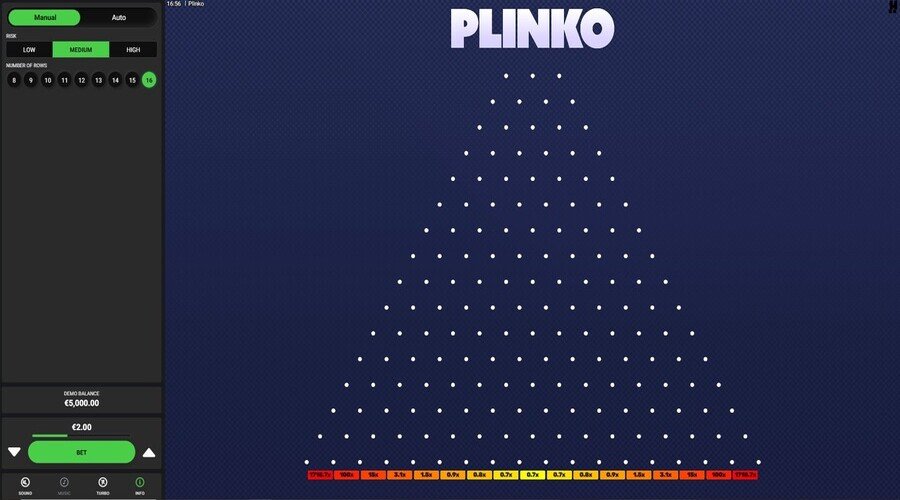
Plinko is an instant game from BGaming, released in 2019, where you drop a ball from the top of a pyramid of pins and your prize depends on the slot where it lands — with a 99% RTP, one of the highest you’ll find in any online casino. Before every drop, you choose the risk level and the number of rows, from 8 to 16.

Key facts
- Provider: BGaming, released in 2019.
- RTP: 99% — and it stays at 99% across every risk and row setting.
- Settings: three risk levels (low, normal and high) and 8 to 16 rows of pins.
- Maximum multiplier: x1000, in the edge slots of the most aggressive setting.
- Modes: manual, one ball at a time, or auto; every round can be checked as provably fair.
- Where it is: Plinko at CaptainsBet is in the Fast Games section, among the instant-round games.
99% RTP on every setting. 18+ only. Bet responsibly.
Plinko game specs at CaptainsBet
Keep two things in mind before anything else: the plinko RTP of 99%, and the fact that it stays fixed whatever you do to the settings.
How does Plinko work?
The ball drops from the top of a pyramid of pins, bounces off every row and lands in one of the slots at the bottom, where the multiplier you get on that ball’s stake is shown. The edge slots are worth far more than the middle ones, and that’s no accident: the ball tends towards the centre, so the edges are, by design, where it almost never lands.
The reason lies in the geometry itself. Every pin is a fork — the ball goes left or right — and the final slot is simply the sum of those turns. To land somewhere in the middle, the turns only need to split roughly evenly between both sides, and a huge number of different paths lead to that result.
To land in an edge slot, on the other hand, almost every turn has to go the same way, and there’s only one path that does it. With plinko 16 rows, that’s sixteen forks in a row: the centre collects thousands of paths, the edges get one each. That’s why the x1000 multiplier shows up on the screen but rarely in your balance.
How to play Plinko: a round in five steps
There’s no betting window and no reaction time needed: at CaptainsBet Plinko, every decision happens before you drop the ball.
Open the game in Fast Games
The pyramid loads with a default setting, which you can change before you bet.
Set the number of rows
Between 8 and 16. The more rows, the more slots at the bottom and the further the edges are from the centre.
Choose the risk level
Low, normal or high. Watch how the numbers in the slots change as soon as you switch level.
Set your stake per ball
Every drop is a separate bet. The limits per round are shown in the game panel, in KES.
Drop the ball and count your rounds
In manual mode, you tap once per ball; in auto mode, set the number of drops before you start.
Does high risk improve my chances of winning?
No — the expected return is exactly the same at all three levels, because the RTP stays at 99% on every setting. Many people assume plinko high risk means “the mode that pays more”; in practice, it just means results become more extreme in both directions.
What the risk setting does is redistribute the same 99%. At low risk, the value is spread across many slots with multipliers close to 1x: you almost always win something and almost never win a lot. At high risk, much of that value is pulled into the two edge slots, and the rest of the bottom row is left with tiny multipliers — most balls return a fraction of your stake, and your return depends on an edge that rarely hits.
In other words: volatility changes, the house edge doesn’t. That’s the key difference from other short-round games, where choosing a level costs you return — in Chicken Road, for example, raising the difficulty really does lower the RTP. In Plinko it doesn’t, and that’s the point worth taking away from this page.
A 99% RTP is a theoretical figure worked out over an enormous number of drops, not a forecast of your balance after half an hour. Even with the lowest house edge you’ll find in a casino, the expected value of every ball is still slightly negative — and at high risk, that average hides whole sessions without a single meaningful result.
How many rows should I choose?
It depends on the kind of session you want: fewer rows give a narrow base, with results grouped near your stake; sixteen rows push the edges away from the centre and make the extremes bigger and rarer. The table combines both settings, because it’s the combination — not each one on its own — that shapes how the game behaves.
In no row of this table does the RTP change. If you compare it with slots and their RTP, where the figure is usually between 95% and 97% and fixed per title, Plinko gives you the opposite choice: a fixed theoretical return and the shape of the results set to your taste.
Managing your money in a game with no breaks
The biggest risk in Plinko isn’t the maths, it’s the pace. A drop takes less than two seconds and there’s no wait between rounds, so a badly set auto mode can burn through dozens of bets in a minute — without anyone deciding anything along the way.
Your defence is three numbers fixed before you open the game: how much the session is worth, how much each ball is worth and how many balls you’ll drop. The third is the one everyone forgets, and the only one that really controls your exposure.
No setting turns a negative expected return into a positive one — what the risk and row choices give you is the way losses or wins are spread along the way. All the deposit, loss and session time limit tools are in the account area of the CaptainsBet Kenya casino platform, and they take less time to set up than a run of ten balls.
What is Plinko’s provably fair system?
It’s the system that lets you confirm, after the round, that the ball’s path was already set before you dropped it and that nobody touched it in between. It works with two parts: a server seed generated by the game and given to you in encrypted form before the round, and a client seed on your side that you can change.
Because the result comes from combining the two, neither side can choose it alone. At the end, the game reveals the original server seed, and anyone can redo the calculation and compare it with the drop they saw. That’s what plinko provably fair means in practice: it’s not a promise that you’ll win, it’s proof that the round wasn’t manipulated — a guarantee the rest of the casino library doesn’t always offer this openly.
Is there a free Plinko demo?
Yes: the demo mode runs with play money, and it’s the best way to see side by side what happens to the bottom of the pyramid when you switch risk or rows. People searching for a free plinko demo usually want exactly that — to compare settings before committing any money.
One honest limit is worth pointing out: fifty balls in practice mode say nothing about the next fifty with real money. Leaving the demo with the feeling that it “was paying well” means taking with you the very illusion that needs to be cleared up.
Plinko and the other instant games
Within the Fast Games section, Plinko at CaptainsBet has the shortest decision of all: you set it up, drop the ball and the result arrives. There’s no exit moment to time, unlike JetX, where the multiplier runs in real time and cashing out is the whole game. That lack of pressure feels comfortable — and at the same time invites you to string rounds together without noticing.
Related guides
- Chicken Road — the four levels and an RTP that drops from 98% to 81%.
- JetX — two bets per round, auto cash out and the Galaxy Jackpot.
- slots and their RTP — volatility, Megaways and progressive jackpots.
- rest of the casino library — categories, providers and demo mode.
Frequently asked questions
In manual mode, you can drop a new ball without waiting for the last one to reach the bottom, so several can fall at the same time. Each one is still a separate bet with its own result.
The edge slots of the most aggressive setting, with high risk and the maximum number of rows. By definition, it’s the hardest slot to reach on the whole bottom row.
Yes, between drops, and the bottom of the pyramid rearranges straight away with the new multipliers. The change only applies to the next balls, never to ones already falling.
No. The chance of every slot is identical in both modes; auto just repeats the same bet without you stepping in. The difference is the pace, which is much faster.
They’re different titles that share the idea of a ball falling through a board of pins. The provider, the look and the multiplier table are different, so always check each game’s info before betting.
The result is settled on the server and recorded in your account, even if you don’t see the drop finish. When you reopen the game, your balance already reflects what happened.
The game keeps a list of recent drops with each multiplier, and the full record is in your account’s bet history. It’s there to check amounts, not to predict the next ball.
Yes, and it’s one of the games that suffers least on a small screen: since there’s no exit moment to time, connection lag doesn’t cost you anything. The pyramid shrinks, the controls move to the bottom and the rules stay the same.
Last updated: September 2026. 18+ only. Please bet responsibly. Online betting in Kenya is regulated by the Gambling Regulatory Authority of Kenya (GRA) — check an operator’s licence at gra.go.ke before you play.


