
Home › Is It Legal in Zambia
Is CaptainsBet Legal in Zambia?
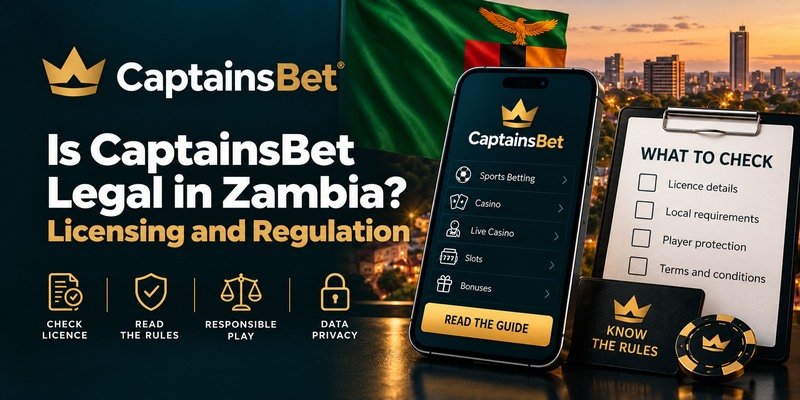
CaptainsBet operates under an international Curaçao licence and does not hold a Zambian licence. Zambia has no dedicated law or licensing system for online gambling, because its local licences cover land-based bookmakers, lotteries and casinos. That leaves offshore sites like CaptainsBet in a grey area. Rather than a simple “legal” or “illegal” label, what matters is the protection you do and don’t get as a player.
Quick answer
- Licence: issued in Curaçao, outside Zambia.
- Zambian licence: none. CaptainsBet isn’t licensed by Zambia’s betting control board under the Betting Control Act.
- Local laws: the Betting Control Act (Chapter 166) and Lotteries Act (Chapter 163), amended by Act No. 50 of 2021, and the Casino Act 1992. None of them sets up an online licensing regime.
- What you don’t get: a complaint route to a Zambian regulator, and the protections that come with a local licence.
- Tax: the 2026 budget kept a 15% withholding tax on winnings from gaming, lotteries and betting, deducted by locally licensed operators.
- A common mix-up: a secure website and a local licence are two different things.
Who regulates betting in Zambia?
Betting in Zambia is regulated under the Betting Control Act, through Zambia’s betting control board. Lotteries fall under the Lotteries Act, and casinos under the Casino Act 1992. These laws decide who can take bets in the country and on what terms.
All three were written with land-based operations in mind, such as betting shops, lottery operators and casinos. Act No. 50 of 2021 amended the betting and lotteries laws, but Zambia still has no separate law or licensing system for online gambling. Local licences therefore cover land-based bookmakers and casinos, not websites run from abroad.
This matters most to you as a player. A local licence isn’t just a stamp. It gives you an authority at home to turn to when something goes wrong. With an offshore operator, that local route isn’t there.
What’s the difference between a Curaçao licence and a Zambian licence?
The key difference is how far away the supervisor is. A locally licensed bookmaker answers to an authority in Zambia, under Zambian law. A Curaçao licence is issued and supervised in the Caribbean, under a different legal system, so any dispute goes through the operator and then the Curaçao regulator.
CaptainsBet licence: who issued it and what it covers
CaptainsBet’s licence was issued in Curaçao and covers the brand’s operation under that jurisdiction. It doesn’t become a Zambian licence just because the site shows kwacha, mentions mobile money or lists Chipolopolo matches among its games and markets. In any honest captainsbet review, the licence is the first thing to check, before the odds, the game catalogue or withdrawal times.
Always check the licence in the footer before you sign up. 18+. Please gamble responsibly.
Zambia’s gambling laws in plain language
Zambia’s gambling rules come from three main laws. The Betting Control Act (Chapter 166) covers betting. The Lotteries Act (Chapter 163) covers lotteries. Both were amended by Act No. 50 of 2021. Casinos are covered by the Casino Act 1992. Under these laws, local operators need a licence before they can take bets or run games in Zambia.
What these laws don’t include is a dedicated online gambling regime. There’s no separate online licence, and local licences cover land-based bookmakers and casinos. As a result, offshore sites licensed elsewhere work in a grey area. They aren’t licensed in Zambia, and there’s no specific online law that sets out rules for them either.
The question comes up in searches in many forms, such as “is captainsbet legal in zambia” and “captains bet legal zambia”. The practical answer is the same each time: no Zambian regime protects that account, because the operator was never part of it. And if a site is ever blocked where you are, don’t try to get around it. Respect the restriction.
What you give up by playing outside the local system
These losses are concrete. There are three protections that simply don’t apply to an account with an operator licensed in another country.
Without a Zambian licence, there’s no complaint process with a Zambian authority. Any dispute stays between you and the operator, with the Curaçao regulator as a last resort.
No Zambian authority checks how your money is held. What protects your balance is the terms and conditions you accepted.
Any limit or self-exclusion you set at CaptainsBet only applies to that account, not to any other betting site.
What is self-exclusion and who does it apply to?
Self-exclusion means asking a gambling site to block you from playing for a set period, or for good. At CaptainsBet you request it inside your account, and it only covers that account.
We haven’t been able to confirm any nationwide online self-exclusion register in Zambia, so you need to ask for a block on each site separately. That’s why the responsible gambling tools in your own account aren’t an extra. With an offshore operator, they’re your main protection. If gambling is getting out of control, also speak to a doctor or visit a health facility near you.
How can I check a betting site’s licence?
Zambia doesn’t have an online licence register we could confirm, so the most reliable check is the licence the site itself claims. It takes less than a minute, and you don’t need to take anyone’s word for it.
Read the footer
Scroll to the bottom of the site and find the licence number and the authority that issued it.
Match the exact name
Compare the brand and the web address letter by letter. Similar names don’t count, because a licence covers a specific domain.
Click the seal
A genuine licence seal opens the regulator’s own page, which shows the licence number and status.
Be wary of seals that go nowhere
An image with no link, or one that points to a page on the same site, proves nothing. A real seal takes you to the regulator’s own site.
Is it safe to play with an internationally licensed operator?
It depends what you mean by “safe”, and it’s worth separating the two meanings. “Technically secure” and “locally licensed” answer different questions, and mixing them up is the most common mistake on this topic.
On the technical side, CaptainsBet is secure in the way any serious site is. The connection between your device and the platform is encrypted with SSL/TLS. You can add two-step verification by SMS. And there’s a KYC check, with your NRC or passport, before your first withdrawal. The rule that withdrawals go back to the method you deposited with, which stops money moving between other people’s accounts, is part of the same package. You’ll find the details on our page about identity checks and payments.
On the legal side, none of this replaces a supervisor. No encryption protocol can force a company to pay out a withdrawal, explain why it voided a bet or reply within a set time. That’s where a local licence makes a difference, and that’s what’s missing here. So register with your real details. A name that doesn’t match your NRC is the most common reason a payout gets held up, and without a local regulator, sorting it out takes much longer.
What about tax on winnings?
The 2026 budget kept the 15% withholding tax on winnings from gaming, lotteries and betting. Locally licensed operators deduct it before you’re paid. An offshore operator isn’t a Zambian licensed operator, so that local deduction doesn’t happen in the same way. If you’re unsure what applies to you, the source to check is the Zambia Revenue Authority (ZRA), either directly or through a qualified tax adviser.
What to do if you have a dispute with an international operator
With no local regulator to step in, the outcome depends a lot on the evidence you collect and the order you do things in. This is the sequence that usually works.
The bottom line: CaptainsBet doesn’t hold a Zambian licence, and nothing changes that. Zambia has no dedicated licensing system for online gambling, so if you play from Zambia, you do so outside the local regulatory system, without a local complaint route. If those protections matter to you, and there are good reasons why they should, weigh this up before you sign up. If you do play, set limits from day one. Ignore anyone offering “predictors” or asking for fees via MTN MoMo or Airtel Money, and never bet with money meant for rent, school fees or a mobile money loan.
Keep reading
- CaptainsBet Zambia home page: an overview of the platform with a quick summary.
- responsible gambling tools: limits, breaks, self-exclusion and where to get help in Zambia.
- identity checks and payments: which documents you’ll be asked for, and when.
- register with your real details: the sign-up form and the mistakes that hold up a withdrawal.
Frequently asked questions
No. CaptainsBet operates under an international Curaçao licence and doesn’t hold a Zambian licence. Any claim otherwise, wherever it comes from, is false.
Betting is regulated under the Betting Control Act, through Zambia’s betting control board. Lotteries fall under the Lotteries Act, and casinos under the Casino Act 1992. There’s no separate licensing system for online gambling.
There’s no dedicated law on online gambling, and local licences cover land-based operators. Offshore sites licensed elsewhere therefore operate in a grey area. They aren’t licensed in Zambia, and no specific online law sets out rules for them.
It’s a licence from another jurisdiction, not a Zambian one. It doesn’t replace a local licence or give you access to a Zambian complaint route.
The 2026 budget kept a 15% withholding tax on winnings from gaming, lotteries and betting, which locally licensed operators deduct before paying out. For winnings from an offshore operator, check with the Zambia Revenue Authority or a tax adviser.
Yes, but because of the operator’s terms and anti-money-laundering rules, not Zambian gambling law. At CaptainsBet you’ll be asked for your NRC or passport before your first withdrawal.
Click on it. A genuine seal opens the operator’s page on the regulator’s website, showing the licence number and current status. A static image, or a link that stays on the same site, proves nothing.
No. This page is for general information and describes the situation as of October 2026. For your own situation, speak to a lawyer, and for tax questions, contact the Zambia Revenue Authority.
Updated October 2026. 18+ only. Please gamble responsibly. In Zambia, betting is regulated under the Betting Control Act, and there is no dedicated licensing regime for online gambling; CaptainsBet operates under an international Curaçao licence and does not hold a Zambian licence.


