
Home › Responsible Gambling
Responsible Gambling in Zambia: Limits, Self-Exclusion and Support
Responsible gambling means the decisions and tools that keep your betting within limits you set before you start, such as a budget, a time limit or a break when you need one. This page covers the tools you can set up in your account, an honest self-check for warning signs and where to find help in Zambia.
Quick answer
- Money you bet is money spent. No strategy turns gambling into an income.
- Three limits: deposit, loss and session time.
- Two ways to stop: a break on your account, or self-exclusion, either temporary or permanent.
- Built to protect you: lowering a limit works straight away, while raising one involves a wait.
- Self-exclusion can’t be cancelled before the period you chose ends.
- Help: talk to a doctor or your local health facility. In Lusaka, Chainama Hills College Hospital is the country’s main psychiatric hospital.
Betting is entertainment, never a source of income
The operator’s margin is built into the odds and the RTP. Over many rounds, the expected result is a loss for the player, whatever system you use. A single session can end in profit, but a long run of sessions usually doesn’t.
Think of a stake as the price of a night out, not an investment you need to win back. This page doesn’t cover licensing, which you can read about on our page on the legal position in Zambia.
Responsible gambling tools in your account
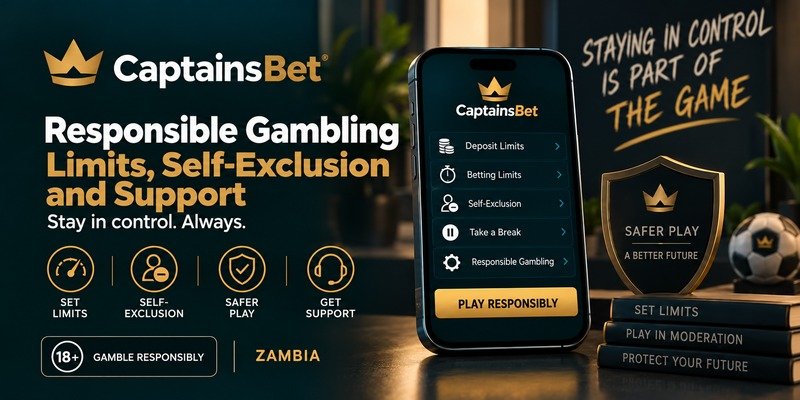
The account area of the CaptainsBet platform has several different tools. What sets them apart is what happens after you switch them on.
The difference in the third column is deliberate. Tightening a limit works immediately, while loosening one means waiting several days. That way the decision is never made in the heat of a session.
Set them up in your account area before you place any bets. 18+. Please gamble responsibly.
How do I set a deposit limit?
Open the responsible gambling section, choose the period and enter the maximum amount in kwacha. A lower limit takes effect straight away. It also helps to set deposit limits that make sense for your mobile money wallet. The cashier shows the minimum amount for each method.
Work out the amount away from the game
Start from what’s left after rent, school fees, food and transport. If nothing is left, your limit is zero.
Open the responsible gambling section
You’ll find it in the account area, next to the security settings.
Choose daily, weekly or monthly
Daily is the strictest, and you can combine periods.
Add the other two limits
A loss limit and a session limit cover the gaps a deposit limit leaves.
Can I cancel self-exclusion before it ends?
No. Self-exclusion can’t be cancelled before the period you chose is over, and that’s exactly why it works. No request to customer support will shorten it. Trying to get around it with a second account usually ends with your balance being frozen, because identity checks pick up the duplicate.
How do I know if gambling has stopped being a pastime?
The money you’ve lost isn’t the best guide. Look at the place gambling takes up in the rest of your life. Answer the questions below with yes or no. They only help if you’re honest, and nobody else will read your answers.
Self-check: yes or no
- Have I bet money I needed for something else, such as rent, school fees or food?
- Have I gone back the same day to win back what I lost?
- Do I hide how much I bet, or that I bet at all, from the people close to me?
- Have I borrowed money to gamble, including a mobile money loan?
- Do I gamble to stop thinking about a problem or a loss?
- Have I decided to stop or cut down and not managed it?
- Have there been arguments at home about money spent on betting?
- Have I lost sleep, skipped work or stopped seeing friends because of time spent gambling?
- Do I feel irritable or restless when I can’t gamble?
Two or more “yes” answers are a reason to act today. Turn on an account break or temporary self-exclusion, and talk to a doctor or your nearest health facility. You don’t need to be sure there’s a problem before asking for help.
Managing your money: four rules that stop the spiral
The tools work better with a plan behind them. Managing your gambling money comes down to four decisions you make away from the game, and the fourth one is what separates an expensive hobby from a problem.
The type of game changes the risk. In fast rounds, the speed shortens the gap between decisions, so a session time limit matters more than a deposit limit. How to play Aviator is the most common question here, and our guide on how to play Aviator covers it. In online slots, high volatility creates long losing runs that tempt you to raise your stake.
How can I keep children away from betting sites?
Use three layers of protection: parental controls, no saved logins and always logging out when you’re done. Real-money gambling is only for people aged 18 and over, and protecting children starts with the phones and computers at home.
Parental control apps and your phone’s built-in filters can block categories of sites for each user profile.
Don’t save your password in the browser on a shared phone. Never share your mobile money PIN, or let anyone watch you type it.
Closing the tab doesn’t log you out of your account. Log out properly and switch on two-step verification.
Where can I get help in Zambia?
We haven’t been able to confirm a dedicated national gambling helpline in Zambia. The best first step is a doctor or your local health facility, and from there you can be referred to mental health services if you need them.
Your doctor or local clinic. A consultation at your nearest health facility is a valid way in, and often the quickest. You can talk about gambling just as you would any other health concern.
Chainama Hills College Hospital, Lusaka. This is Zambia’s main psychiatric referral hospital. Ask your clinic or doctor about a referral if you need specialist support.
Someone you trust. A family member, friend, counsellor or faith leader can help you take the first step. If you ever feel unsafe or in crisis, go to the nearest hospital straight away.
What to say to someone close who’s struggling
Start with what you’ve noticed, not with your judgement. Saying “I’ve noticed you’ve been betting late into the night and you seem worried” opens a conversation. Saying “you’re addicted” shuts it down. Shame is the main reason people hide the problem.
It helps to choose a calm moment, offer to go with them to the first appointment and not quietly pay off their gambling debts. Clearing a debt while nothing else changes usually just delays getting help. Family members can also speak to a doctor or counsellor themselves about how to support someone.
Keep reading
- legal position in Zambia: which protections you don’t get with an offshore operator.
- set deposit limits: mobile money, minimums and processing times.
- how to play Aviator: rules, auto cash out and why short rounds need discipline.
- online slots: RTP, volatility and what those numbers really mean.
Frequently asked questions
No. Setting limits, taking a break and switching on self-exclusion are all free. They don’t depend on your balance or on any promotion.
No. A deposit limit only stops new money coming in. To control what’s already there, use a loss limit, and to control your time, use a session time limit.
Raising a limit involves a waiting period of a few days before it applies. Lowering one is the opposite: it takes effect as soon as you confirm it.
Your access is blocked, but your balance doesn’t disappear. Request a withdrawal before you confirm self-exclusion, or sort it out with customer support.
Yes, that’s what an account break is for. It blocks access for a short period and ends by itself when the time is up, with no explanation needed.
Yes. Family and friends can speak to a doctor or health facility themselves, and that’s often where the first conversation happens. It helps you understand what to say and what support is available near you.
No. Each operator only applies the settings of its own account. If you want to stop yourself on several sites, you need to set up limits on each one.
Updated October 2026. 18+ only. Please gamble responsibly. In Zambia, betting is regulated under the Betting Control Act, and there is no dedicated licensing regime for online gambling; CaptainsBet operates under an international Curaçao licence and does not hold a Zambian licence.


